Forty-Five Miles an Hour to Nowhere in Particular: Chasing America's Forgotten Two-Lanes
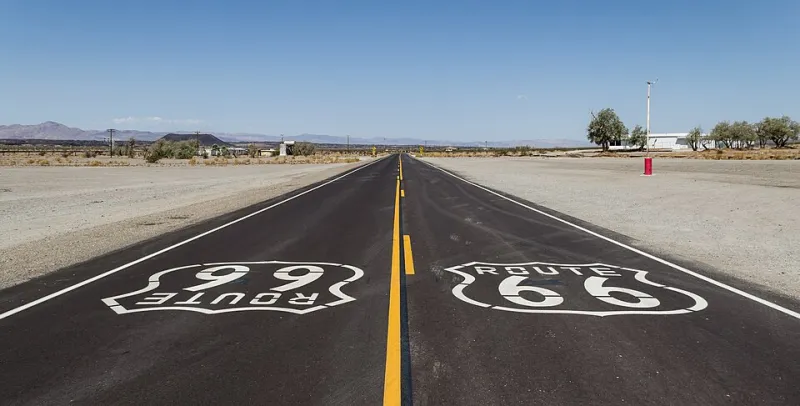
Photo: Dietmar Rabich, CC BY-SA 4.0, via Wikimedia Commons
There's a moment that happens on a two-lane road that never happens on an interstate. You crest a hill in central Nevada, the highway unspooling ahead of you in a dead-straight line for twenty miles, no billboards, no exit signs, no evidence another human has passed you in an hour — and you realize you have absolutely no idea what's over that next rise. On I-80, you'd know. There'd be a sign. Out here, the not-knowing is the whole point.
We've been quietly giving away the best driving in America for seventy years. The interstates built after 1956 were engineering miracles, and they're also a filter — they let us skip everything that wasn't deemed important enough to exit toward. What got left behind was thousands of miles of two-lane asphalt running through towns that never got a billboard, diners that never made a list, and landscapes you can only absorb at a speed slow enough to actually see them.
What the Interstates Skipped
Start with the famous example: US Route 50 across Nevada, which Life magazine dubbed "The Loneliest Road in America" in 1986 — an insult the state has been proudly milking ever since. The AAA map said avoid it. What the map didn't mention: the road crosses a series of vast basin-and-range valleys, each one flanked by snow-dusted mountain ranges, with almost nothing between you and the horizon. You pass through Austin and Eureka, mining towns that time didn't so much forget as politely decline to bother. There's a hotel saloon in Austin that's been pouring drinks since 1863.
Or take the coastal two-lanes. Highway 1 in California gets the fame and the traffic, but the Oregon coast's Highway 101 north of Newport, or North Carolina's Highway 12 down the Outer Banks, deliver the same ocean-out-your-window feeling with a fraction of the crowds. Then there are the mountain passes — Colorado's Million Dollar Highway between Silverton and Ouray, West Virginia's Highland Scenic Highway — roads that exist purely because the view demanded a route.
Planning a Trip With No Interstates
The good news: this is one of the easiest trips to plan and one of the hardest to over-plan.
Pick a corridor, not a destination. Choose a single two-lane route — US 50, US 61 along the Mississippi, Highway 12 through Utah — and give yourself permission to go slow. A blue highways trip isn't about covering miles; it's about the ratio of stops to miles.
Use the paper-map trick. Yes, on your phone. Open a map app, switch off highways in the route settings, and see what the country looks like when you forbid yourself the interstate. The routes that appear are the ones America used before 1956.
Budget for time, not speed. A 300-mile day on a two-lane is a full day. Plan roughly half the daily mileage you'd attempt on an interstate trip, then cut it again.
Book almost nothing. The whole appeal is improvisation. The one exception: remote stretches of Nevada and Utah can have genuine lodging gaps, so know your overnight options before you commit to the loneliest stretches.
The Stuff You Only See at 45
Here's what 75 mph filters out: the hand-painted sign for a rock shop that's been open since 1971. The county fair banner. The cafe with a single pickup truck parked out front and a pie cooler by the register. The giant roadside folk-art thing — a hole-in-the-rock, a woolly mammoth made of car parts — that some person built because they wanted to, not because a tourism board approved it.
At interstate speed, towns are services: gas, food, lodging. At two-lane speed, towns are people. Stop for coffee in a place like Eureka, Nevada, or Clarksdale, Mississippi, and you'll end up in a conversation you couldn't have bought a ticket to. Locals in these towns aren't jaded by tour buses because the tour buses don't come. You are, briefly, the most interesting thing that happened today.
And then there's the road itself. On a two-lane, the drive stops being transit and becomes the attraction. You notice the shift from sagebrush to piñon. You pull over for a herd of cattle and a wave from the rancher moving them. The road becomes the destination because, honestly, there's nothing else demanding to be.
A Few Ground Rules
Fuel up when you can, not when you need to — gaps of 80-plus miles without services are real. Download offline maps; cell coverage on the Loneliest Road is a rumor. Tell someone your route on the truly remote stretches. And patronize the local places: the diner, the bar, the gas station with the good jerky. These towns survive on travelers who stop. Be one of them.
The interstates will always be there, getting you there faster. But faster to what, exactly? Somewhere out there past the last exit ramp, America is still unspooling at 45 miles an hour, one unexpected hill at a time. Go find out what's over the next rise.